
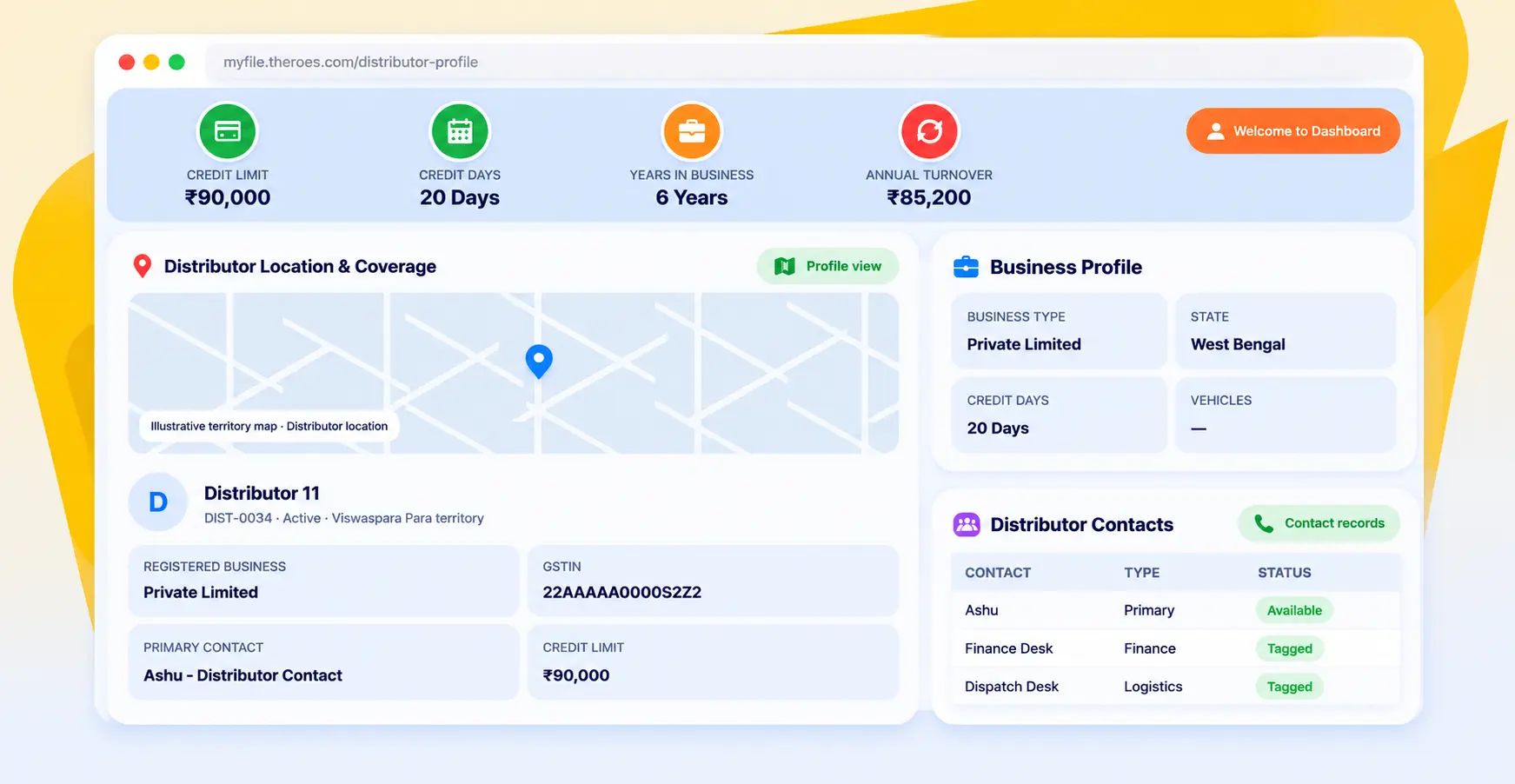
Distributor Onboarding . Business Profiles . Credit Visibility

Distributor management software that brings your entire distributor network into focus.

Build complete distributor profiles, organise business and tax information, manage key contacts, map business locations and configure credit terms from one central system. Give your sales, finance and operations teams a consistent view of every distributor relationship.

A structured foundation for distributor relationships across sales, finance and distribution operations.

Distributor business profile
360°
Contact and address records
Multi
Business tax identity details
GST
Credit and lifecycle status
Clear

The Distributor Data Challenge

When distributor information is scattered, every team works with an incomplete picture.

A distributor relationship involves more than a name and phone number. Legal identity, tax registration, business contacts, operating locations and credit terms all influence day-to-day decisions. When those details are incomplete or difficult to find, onboarding and ongoing coordination become harder to manage.

Incomplete distributor records

Basic contact details alone do not tell your team which legal entity they are dealing with, what business structure the distributor operates under or which registration details belong on business documents. Missing information can create avoidable back-and-forth during onboarding and invoicing.

Important contacts are hard to reach

The person placing orders may not be the person handling payments or coordinating deliveries. If every conversation depends on one primary contact, finance and logistics teams can struggle to reach the right person at the right time.

Business addresses lack structure

A distributor's registered office, billing address and warehouse may be in different locations. Treating them as one address can create confusion for documentation, billing coordination, territory visibility and delivery planning.

Credit terms are difficult to track

Credit limits, payment days and total outstanding exposure serve different purposes. If those rules are not clearly configured, sales and finance teams may not have a consistent view of the distributor's permitted credit and payment expectations.

The Distributor Data Challenge

Give every distributor a complete, structured business identity.

MyFieldHeroes Distributor Management brings the key details of each distributor into a central profile. Capture trade and legal names, business type, registration numbers, primary and additional contacts, distinct business addresses, operating information and financial configuration. Your teams can work from a more complete and consistent distributor record.

One complete distributor profile

Keep distributor codes, legal identity, business type, registration information and business details together in a structured record.

The right contact for each task

Maintain primary, alternate, emergency, finance and logistics contacts with contact types that help teams identify the right point of contact.

Clearer financial configuration

Configure credit limits, credit days and maximum outstanding thresholds to support more consistent distributor account management.

The Distributor Data Challenge

Everything important about a distributor, organised in one place.

Maintain accurate legal and business profiles

Give every distributor a system-generated, immutable distributor code that can be used in external documents instead of internal database IDs. Store the everyday trade name separately from the registered legal entity name, so teams can identify the business correctly and use the legal name where required on GST invoices. Record the business structureIndividual, Partnership, Private Limited, Public Limited, LLP or Proprietorship along with GSTIN, PAN, CIN and business registration details. Entry-time format validation helps catch incorrectly formatted registration numbers before they become part of the distributor record.
Image description

Keep primary, finance and logistics contacts connected

Store primary contact information directly on the distributor profile for quick access. Add additional contacts for alternate, emergency, finance and logistics communication, with each contact tagged by its purpose. Contact types help the system identify who should receive relevant communication. For example, payment-due notifications can be directed to the finance contact, while delivery ETA updates can be directed to the logistics contact. Maintain the contact structure your distributor relationship requires without relying on a single point of contact.
Image description

Separate registered, billing and warehouse addresses

Distributor locations often serve different business purposes. Maintain a registered address for legal and registration records, a billing address for billing coordination and a warehouse address for stock and operational reference. Keep latitude and longitude with the distributor's location information to support map-based territory visualisation and route-planning workflows. Distinct address records help teams understand which location they are referring to instead of treating every address as interchangeable.
Image description

Understand distributor capacity and business background

Capture years in business, annual turnover, number of employees, delivery vehicles and sales representatives as part of the distributor profile. These details give the manufacturer a more useful view of the distributor's declared business scale and operating capacity. The information can feed an onboarding scorecard used to support initial credit-limit and territory-size decisions. It can also help compare declared business capacity with actual utilisation over time, where the relevant operational data is available.
Image description

Configure credit limits, payment days and exposure thresholds

Set distributor credit limits and credit days to define the commercial terms associated with the account. Credit days represent the agreed payment period—for example, Net 30—and can support payment-due and outstanding-ageing workflows. Configure a maximum outstanding amount separately from the credit limit. The credit limit governs eligibility for new orders, while the maximum outstanding amount represents the absolute outstanding ceiling, including approved exceptions. This separation gives finance and sales teams clearer parameters for managing distributor exposure.
Image description

Track each distributor's relationship status
Use a defined distributor lifecycle to make the current relationship stage visible to the teams working with the account. The configured statuses cover the journey from a new prospect through review and active operations, as well as situations where an account is suspended, blocked or terminated. A consistent status model gives teams a shared vocabulary for understanding where a distributor stands. It also provides a structured foundation for managing distributor records throughout the relationship.
Image description

GST-Aware Distributor Records

Connect distributor tax identity with the right invoicing context.

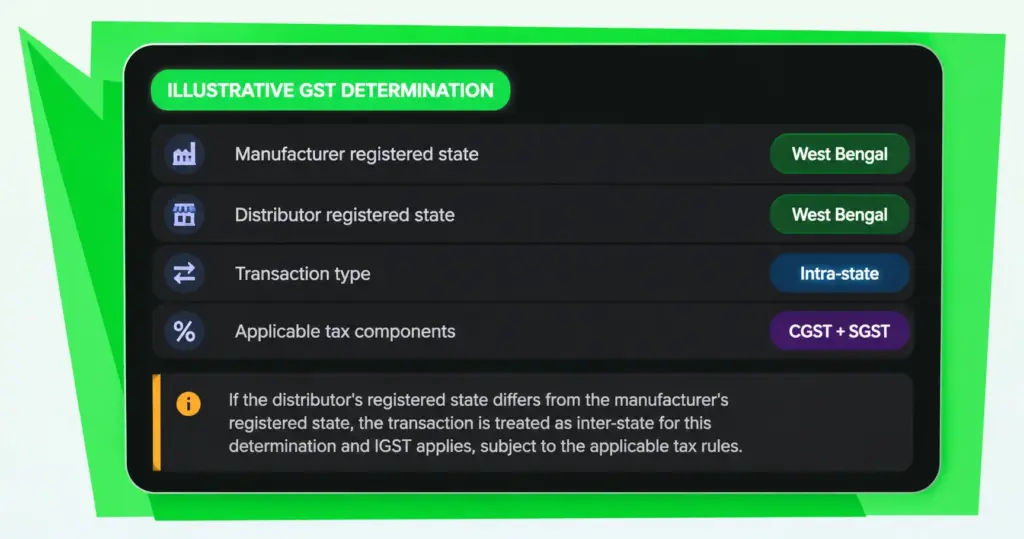
A distributor’s GST registration details are important beyond record keeping. The registered address state provides the source information used to determine whether a transaction is intra-state or inter-state when compared with the manufacturer’s registered state.

That state comparison determines the applicable tax treatment: CGST and SGST for intra-state transactions, or IGST for inter-state transactions. Maintaining the distributor’s GST and registered-address information gives the invoicing workflow the relevant source data for tax determination.

Keep the distributor’s legal entity name and registered address clear in the profile so teams can refer to the correct business identity during invoice preparation.

Distributor Onboarding . Business Profiles . Credit Visibility

More reliable distributor data starts with better structure.

Keep essential identity, contact, location and financial information organised in a way that supports the teams responsible for distributor onboarding and ongoing account management.

System-generated distributor code

Assign a unique, system-generated and immutable distributor code for consistent identification in external documents and internal workflows.

Business registration information

Record GSTIN, PAN, CIN and business registration numbers, with format checks at entry to help maintain cleaner records.

Purpose-based contact records

Separate primary, alternate, emergency, finance and logistics contacts so communications can be directed to the relevant role.

Business and financial context

Bring declared business capacity, credit terms, maximum outstanding threshold and lifecycle status into the distributor profile.

A Structured Onboarding Flow

From distributor details to a usable business profile.

Create the distributor record

Capture the distributor's name, legal entity, business type and system-generated distributor code.

Add contacts and locations

Record primary and additional contacts, registered, billing and warehouse addresses, and map coordinates.

Configure business and credit details

Enter registration identifiers, operating capacity, credit limit, credit days and maximum outstanding amount.

Maintain lifecycle status

Track the distributor through the configured relationship stages as the business relationship progresses.

Questions people ask before Signing Up.

What is distributor management software?

Distributor management software helps businesses organise and manage distributor information and relationships. MyFieldHeroes Distributor Management provides a structured profile for distributor identity, legal and tax details, contacts, business locations, operating information, credit configuration and lifecycle status.

What information can we maintain in a distributor profile?

The profile can include a system-generated distributor code, trade name, legal entity name, business type, GSTIN, PAN, CIN, business registration number, primary contact information, additional contacts, registered address, billing address, warehouse address, business background and financial configuration.

Can we store multiple contacts for one distributor?

Yes. In addition to primary contact information, the distributor contact structure supports additional alternate, emergency, finance and logistics contacts. Each contact can be tagged by type to help route relevant communication to the right person.

Why are registered, billing and warehouse addresses maintained separately?

These addresses can serve different purposes and may not be the same physical location. The registered address is relevant to legal and GST registration details, the billing address supports billing coordination, and the warehouse address identifies an operational location. Keeping them separate reduces ambiguity.

How does distributor GST information support invoicing?

The distributor’s GSTIN and registered-address state provide important source information for tax determination. Comparing the distributor’s registered state with the manufacturer’s registered state helps identify intra-state transactions, where CGST and SGST apply, or inter-state transactions, where IGST applies, subject to applicable tax rules.

What is the difference between credit limit and maximum outstanding amount?

The credit limit governs eligibility for new orders. The maximum outstanding amount is a separate absolute ceiling on the distributor’s total outstanding exposure, including approved exceptions. Maintaining both gives sales and finance teams distinct controls.

Can we define credit days for distributors?

Yes. Credit days capture the distributor’s payment terms, such as Net 30. These terms can be used by related payment-due notification and outstanding-ageing workflows.

Which distributor lifecycle statuses are supported?

The defined lifecycle includes Prospect, Under Review, Active, Suspended, Blocked and Terminated. This provides a consistent way to identify the current stage of a distributor relationship.

Can distributor business details support onboarding decisions?

Business details such as years in business, annual turnover, employee count, delivery vehicles and sales representatives can feed an onboarding scorecard. The scorecard is intended to support decisions such as initial credit limit and territory size, and can help compare declared capacity with actual utilisation when operational data is available.

Stop Managing Blind.

Start Leading with Data.

Book a 20-minute demo. We’ll show you exactly how MyFieldHeroes fits your workflow- whether you run 5 MRs or 500 field reps.

Secret Link